


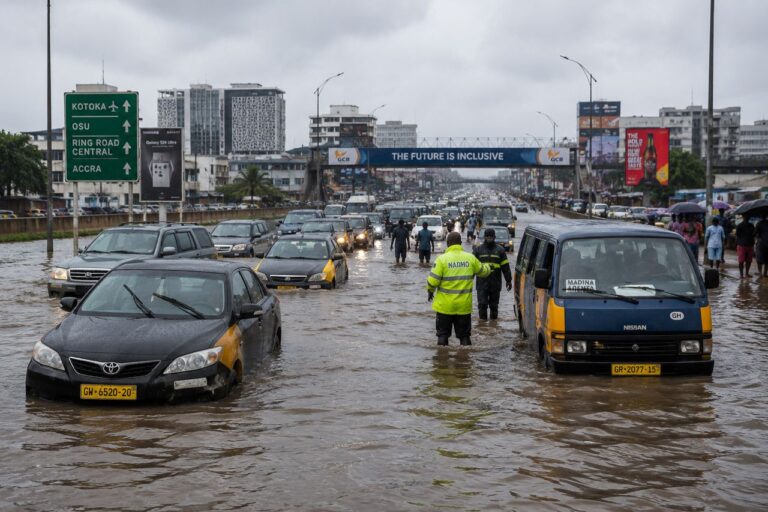
On Monday June 29, 2026, Accra didn’t just flood; it surrendered. As major arteries submerged and thousands found themselves stranded, the narrative remained hauntingly familiar: “The rains were heavy.” But that is a convenient fiction. The rain is a meteorological event; the disaster, however, is a human choice.
In Accra, we have moved past the era of ‘natural disasters’ and entered an era of ‘predictable negligence.’ Every rainy season, we witness the same tragedy. We document it with the same smartphones, express the same frustrations, and watch the water recede, only to return to our comfortable silence until the next cloud gathers.
Following the torrential downpour of June 29, 2026, which saw a staggering 140+ millimetres of rainfall in a single day, President John Dramani Mahama’s aerial inspection revealed the grim reality of a city gasping for air. “This means that our waterways no longer have sufficient time to recover before more rain falls,” the President noted, highlighting that June rainfall in the capital has surged from 85 millimetres in 2024 to an overwhelming 333 millimetres in 2026.
The President’s acknowledgment that Accra’s physical layout, marred by rapid urbanisation and structures built along natural water paths, is the true culprit, is a long-overdue admission. Yet, declaring a “nationwide crackdown” and releasing GH¢300 million in contingency funds, while necessary, remains a reactive patch on a systemic wound.
Accra is not alone in this drowning. Across the continent, African cities are paying the price for decades of planning failures. In March 2026, Nairobi’s flash floods claimed dozens of lives and caused USD 300 million in infrastructure damage, exposing the same lethal intersection of colonial-era drainage, unchecked encroachment on riparian reserves, and climate-induced rainfall intensity.
From Ethiopia’s landslides to the inundation of rice fields in Ghana’s Ketu North, the pattern is clear: our cities are expanding faster than our governance can manage.
As journalists, our responsibility cannot end with documenting destruction. Climate journalism should not only report the chaos, it must interrogate the systems that permit it.
We have become remarkably good at filming the flood. We have not become equally committed to exposing the political and economic choices that turn rain into tragedy.
This year, the TN Africa Digital Journalism Summit will convene under the theme: Drawing the Flood Line: Climate Resilience, Urban Planning and Africa’s Future. We chose this title because for too long, we have drawn the line only after the disaster strikes. We map communities after they are ruined; we inspect drains after they have failed.
We must shift the #StoryTheChange movement from awareness to implementation. We need journalism that investigates the real estate developers encroaching on wetlands, the planners ignoring environmental impact assessments, and the leaders prioritizing short-term convenience over long-term survival.
The flooding we witnessed this week should not be another forgotten headline. It should be a turning point.
Resilience is not built with sandbags during an emergency; it is built through the difficult, unpopular, and courageous decisions made long before the skies turn dark. The next rain is already on its way. The only question that remains is whether we will still be asking the same questions when it arrives, or if we will finally choose to act while we still have the chance.
Africa deserves cities designed for resilience, not recovery. It deserves leaders willing to act before disaster forces their hand. And it deserves a brand of journalism that holds that power to account, long after the cameras leave the water.
By Senanu Damilola Wemakor
Climate Activist/Lead Convener, TN Africa Digital Journalism Summit