


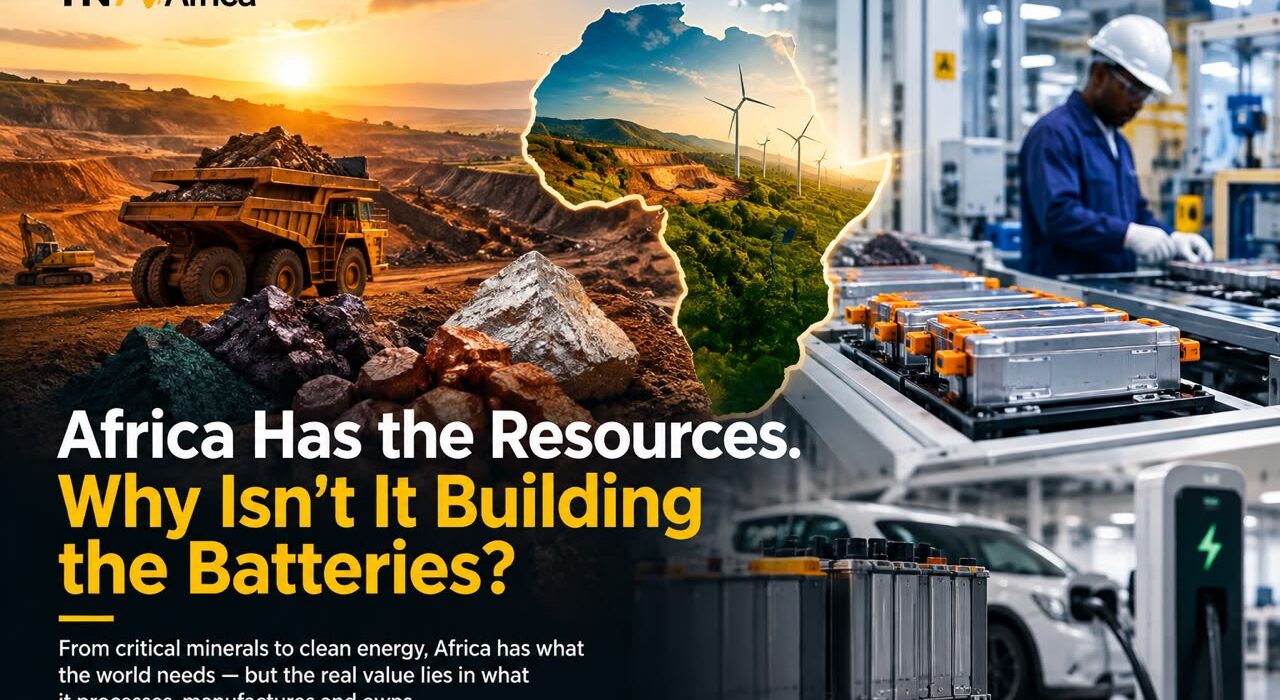
Africa’s critical minerals are central to the global energy transition, but the continent’s economic gains will depend on what it processes, manufactures, and owns at home.
Africa’s mineral wealth is helping power the global transition to cleaner energy, yet the continent faces a familiar economic question: will it once again supply the raw materials while other economies capture the higher-value industries, technology and jobs?
At the 81st United Nations General Assembly, Ghana’s President John Dramani Mahama called for African countries to process their critical minerals locally and retain more of the value generated from their natural resources. The challenge is turning that demand into an industrial strategy that can work across national borders.
The global transition to electric vehicles, renewable energy and other low-carbon technologies has increased the importance of minerals used in batteries, power systems and industrial equipment. African countries possess deposits of several minerals relevant to these supply chains, giving the continent an opportunity to play a more consequential role in the emerging energy economy.
But possessing a resource does not automatically confer economic power.
A country can extract and export a mineral while the more profitable stages of the supply chain-, processing, refining, component manufacturing, technology development and branding- take place elsewhere. The exporting country may receive royalties, taxes and wages, but it can miss opportunities to build a wider industrial base.
The United Nations has warned that rising demand for critical energy-transition minerals could reinforce commodity dependence and expose producing communities to environmental and social costs unless countries and communities benefit more directly from the value generated. Its work on critical minerals has therefore emphasised local value addition, transparency, sustainability and stronger international cooperation.
The issue is not whether Africa should participate in global mineral markets. It is whether African countries can move beyond supplying those markets to building industries around them.
Ghana’s call at the UN
In his address to the General Assembly on September 24, 2026, President Mahama argued that critical mineral extraction must not reproduce colonial-era patterns in which Africa supplied raw resources while industries and employment developed elsewhere.
He called for local processing, industrial development and dignified jobs for young people, linking the agenda to the African Continental Free Trade Area (AfCFTA), whose Secretariat is based in Accra.
The argument also featured in wider UN discussions about Africa’s development and resource governance. In remarks opening a General Assembly debate on the New Partnership for Africa’s Development on October 12, the Assembly President, Khalilur Rahman, pointed to a gap between legal ownership of strategic assets and the institutional capacity to govern the value they generate. He cited a UN report finding that African states capture, on average, about 40 per cent of the revenue their resource wealth could yield.
That figure is a reminder that resource ownership alone does not guarantee that countries receive the full public benefit from extraction.
The revenue gap can reflect several challenges, including weak negotiating capacity, limited tax administration, contract terms, illicit financial flows and the difficulty of enforcing rules across complex international supply chains. Addressing these issues requires more than a declaration that minerals should be processed locally.
Mineral processing and manufacturing need reliable electricity, transport, water, skilled workers, technology, finance and access to markets. Without these foundations, local processing may be too expensive or unreliable to compete with established industrial centres.
Governments must therefore connect mining policy to energy planning, technical education, infrastructure investment and support for local businesses. They also need to establish clear environmental standards and ensure that the economic benefits reach communities affected by extraction.
This is not an argument for every African country to build every stage of every supply chain. Some industries require investment and market sizes beyond what a single country can sustain. Regional production networks could allow countries to specialise in different stages, share infrastructure and serve a larger market.
A mineral-producing country might supply raw materials, while another develops processing capacity and another manufactures components. If supported by dependable transport, power systems and predictable trade rules, such arrangements could make African production more competitive.
The World Bank’s 2026 report, Integrating Africa: From Threads to Hubs, argues that regional markets can help African firms specialise, invest and grow. It identifies the connection between mineral extraction, processing and manufacturing as one of the opportunities for deeper regional production.
AfCFTA could provide a framework for that cooperation, but its promise depends on implementation. Customs procedures, transport costs, standards, payments and cross-border regulations must work well enough for businesses to operate across countries.
Who benefits from the transition?
The measure of success should extend beyond export earnings and the number of processing plants announced.
It should include the jobs created for African workers, the technical skills transferred, the opportunities available to local suppliers, the taxes collected and the share of revenue invested in public services. It should also account for the environmental costs borne by mining communities and whether affected people receive adequate protection and a fair share of the benefits.
Investors need predictable rules and commercially viable projects. Governments need a stronger revenue base and a broader economy. Communities need decent work, environmental safeguards and visible public benefits. These interests do not always align automatically; good governance must bring them together.
Africa also needs to avoid replacing one form of dependence with another. Local processing that relies entirely on imported equipment, external expertise and foreign financing can create industrial activity without building sufficient domestic capacity. Partnerships must therefore include skills development, technology transfer and opportunities for African businesses to move up the supply chain.
The global energy transition creates a window of opportunity, not a guarantee of prosperity. Whether African countries benefit will depend on the terms they negotiate, the institutions they build and the markets they create together.
TN Africa’s Take
Africa should not measure its success in the energy transition by how much of its mineral wealth leaves its shores. The more important measure is how much productive capacity, skilled employment, public revenue and industrial ownership remains at home. That requires capable institutions, transparent contracts, environmental accountability and regional cooperation—not simply a ban on exporting raw materials. Africa has an opportunity to build more of the industries that its resources make possible; the test is whether its leaders can turn that opportunity into lasting economic power.
Source: The Newsroom Africa